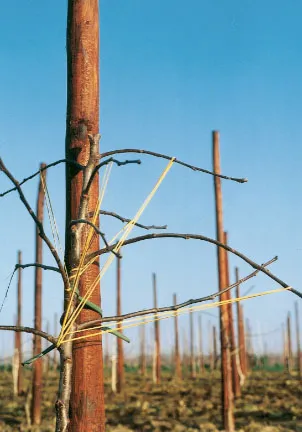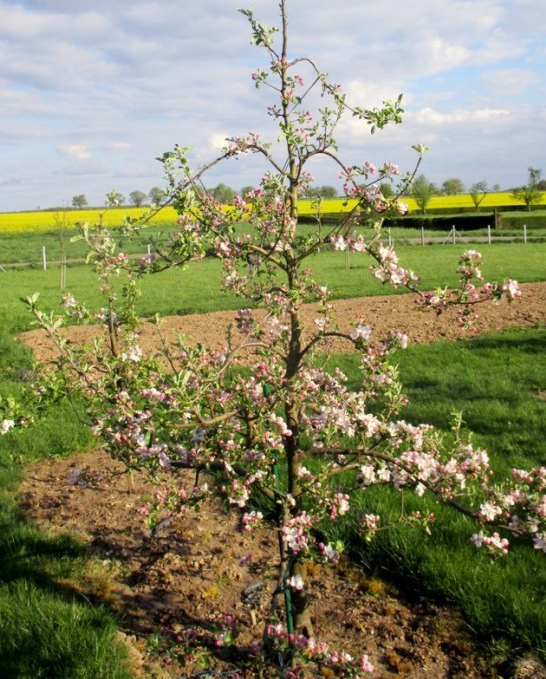


Why is bending the lateral twigs decisive?
In modern orchards — especially those trained as tall spindle, super spindle or vertical axis — the speed of entering production largely depends on the angle of the lateral twigs (feathers).
The more horizontal a twig is, the more it:
-
reduces vegetative vigour,
-
develops spurs and fruiting buds,
-
improves light penetration,
-
accelerates commercial production.
For decades, orchardists have used fixing elastics (“twig-style fix bands”, “limb-fixing elastics”, “branch-fix rings”, etc.) to bend young twigs simply and economically.
How do these twig fix elastic solutions work?
Elastic systems for bending twigs are based on a simple principle:
-
One end is looped around the main trunk.
-
The other end is slipped onto the twig to be lowered.
-
The tension of the material holds the twig at the desired angle.
Agronomic goal:
-
Bend the twigs between 80° and 100° relative to the trunk,
-
Slow vegetative growth,
-
Promote mixed buds and thus early fruiting.
Limitations of traditional synthetic rubber (EPDM) systems
Many products on the market use synthetic materials (EPDM). These are valued for low cost but have several drawbacks:
-
Too long before breaking,
-
Degradation can be uneven depending on sunlight,
-
Residues or fragments may remain on the ground for months,
-
Risk of leaving the twig restrained too long, which can mark the bark or reduce flexibility,
-
Less natural approach than natural rubber.
Producers increasingly look for ecological, predictable, and faster-degrading alternatives.
The Bandex alternative: natural rubber elastic with programmed breakage
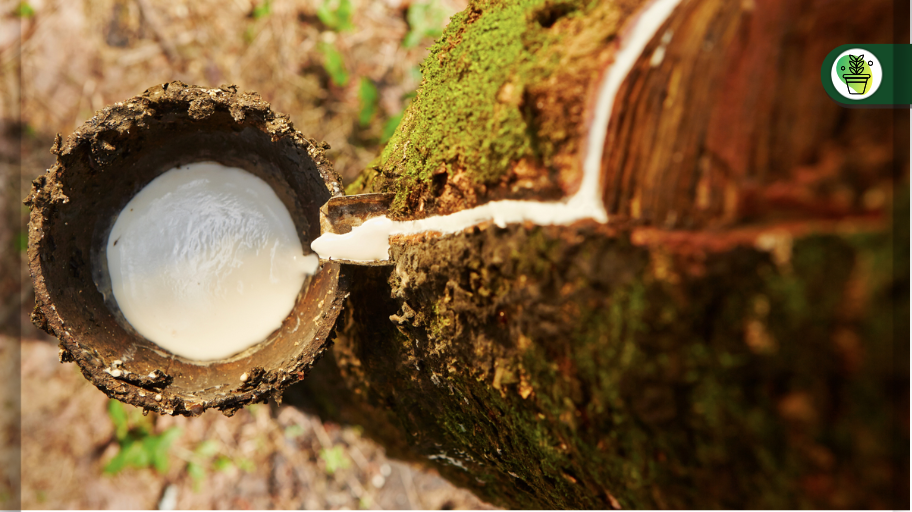
For orchardists seeking a natural, fast, and controlled solution, Bandex offers a natural rubber elastic, designed to bend young apple and pear twigs.
Major differences compared to synthetic systems
| Criterion | Synthetic systems (EPDM) | Bandex Elastic (natural rubber) |
|---|---|---|
| Degradation | Very long | 20–30 days |
| Material type | Synthetic | Natural rubber |
| Breakage | Sometimes irregular | Predictable: controlled UV breakage |
| Risk of marking twig | Higher if forgotten | Very low due to short duration |
Why a 20–30 day breakage is an advantage
-
✔ The twig remains held only long enough to stabilise its new orientation.
-
✔ The elastic breaks quickly, preventing marks and bark injury.
-
✔ Ideal for orchards with limited labour.
-
✔ Compatible with sensitive young trees, apples or pears.
Installation method: recommended protocol
Steps for optimal installation
-
Choose the right time: apply when young twigs are still flexible (late spring / early summer).
-
Create the anchor point: wrap one loop around the trunk just below the twig to be bent.
-
Attach the elastic to the twig: carefully position the twig and slide the second loop until the desired angle is achieved.
-
Check the angle: aim for horizontal (90°), avoid excessive tension.
-
Let the elastic work: Bandex elastics naturally break after 3–4 weeks, eliminating additional intervention.
Which training systems require this type of “twig-fix” band?
-
🌱 Tall spindle: allows early production from the 2nd or 3rd leaf with fine vigour control.
-
🌱 Super spindle / Hi-density: finer, more reactive twigs require a flexible, non-traumatic material.
-
🌱 Palmette pear orchards: pear varieties (Conference, Abate, Comice…) respond well to horizontal bending. Bandex prevents frequent damage on stiffer varieties.
Available elastics: sizes and uses
Available elastics: sizes and uses
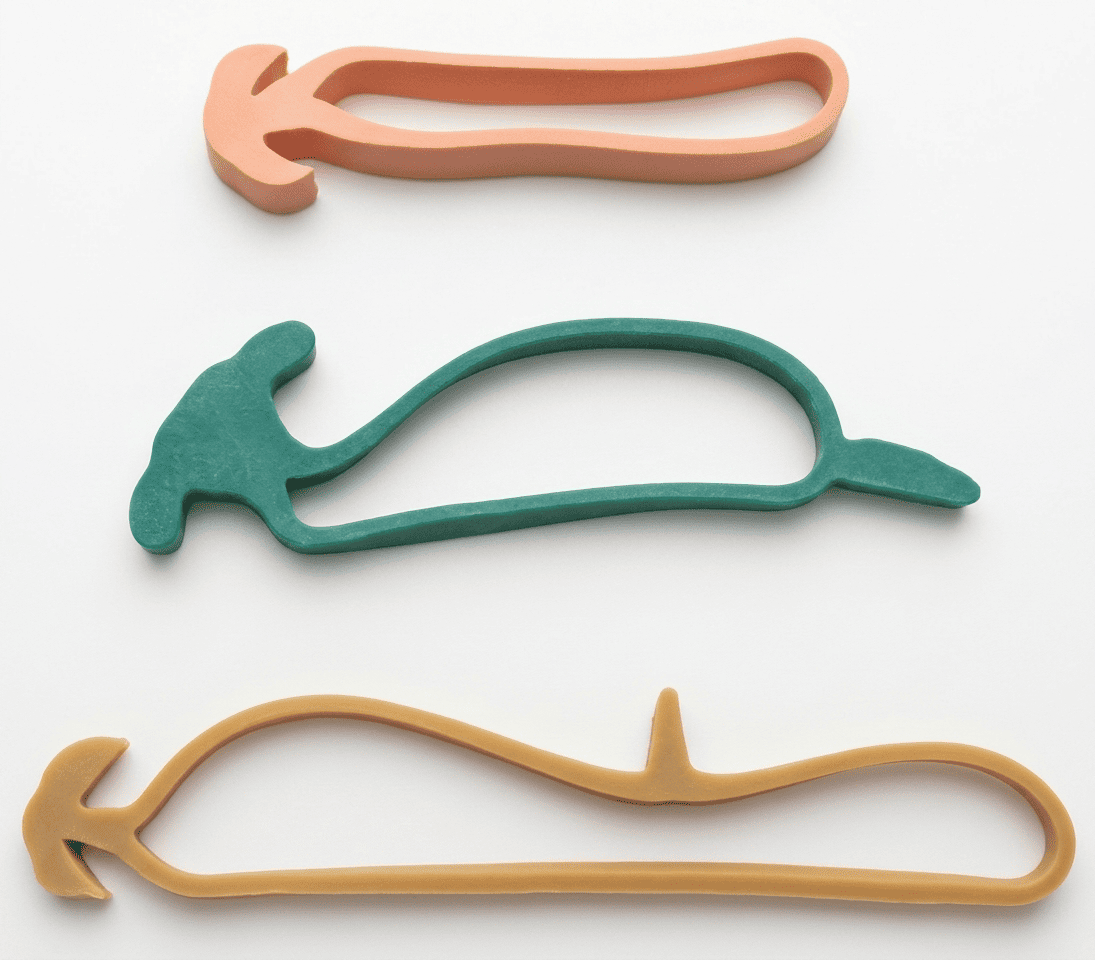
As a manufacturer, we offer different lengths to suit your needs (16 cm, 22 cm, 27 cm…):
-
Short elastics → fine young twigs
-
Medium length → standard lateral twigs
-
Long elastics → large secondary axes or vigorous pears
High-density orchards demand:
-
Fine vigour management,
-
Fast installation,
-
Reduced labour.
Bandex elastics, with programmed breakage in 20–30 days, offer a modern, clean, and controlled solution.
For professional apple and pear growers, Bandex is now a reliable standard to bend twigs from the first years.
![Bandex | [Video] Tutoring and Espalier of Vineyards and Olive Trees with Anchor Bands](https://rubberbandex.com/wp-content/uploads/2026/02/tuteurage-vigne-elastiques.png "Bandex | [Video] Tutoring and Espalier of Vineyards and Olive Trees with Anchor Bands")