

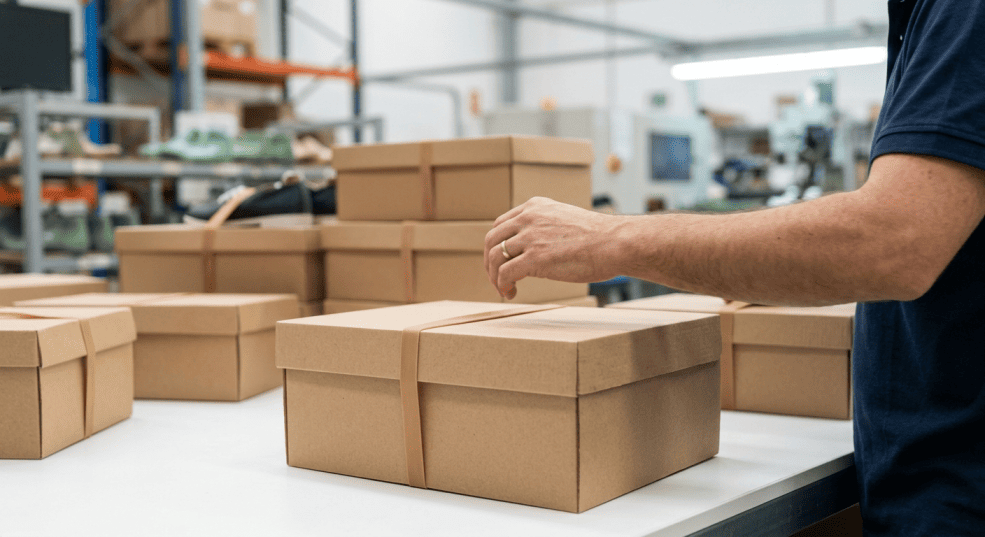
In a footwear production line, shoe boxes are not opened and closed just once. They are handled during quality control, in the warehouse, during order picking, at the point of despatch, and frequently throughout returns and repackaging processes as well. Every time a box changes hands, it needs to be closed quickly, securely and without damaging the cardboard.
Yet many businesses in the sector continue to rely on solutions that were never designed for this pace of work: packing tape that prevents a clean second opening, shrink wrap that generates waste, or simply unsealed boxes that come open during internal transport. The result is lost time, a steady accumulation of disposable consumables, and damaged packaging that fails to reflect the quality of the product inside.
There is a more efficient, more sustainable and more cost-effective alternative: the industrial rubber band.
The Real Packaging Problem in the Footwear Industry
The footwear industry is characterised by an extraordinarily high volume of packaging. A single product reference can generate thousands of boxes per season, and each one travels a long way before it reaches the point of sale or the end customer.
Repeated Opening and Closing Throughout Production
From the moment a product leaves the assembly line to the point of despatch, a shoe box is opened and closed multiple times: for product inspection, insertion of accessories (spare laces, care instructions, gift items), random quality control checks or last-minute corrections.
With traditional packing tape, every opening means using more tape. At an industrial scale, this represents a continuous expense and a level of waste that is increasingly difficult to justify.
Stock Management and Warehouse Rotation
In the warehouse, boxes are in constant movement — stacked, relocated, sorted by size, by style, by destination. A poorly closed box or one with partially detached tape is a risk: product contamination, mis-picks and fulfilment errors all become more likely.
Order Picking and Despatch
In order preparation — particularly in the high-volume environments typical of specialist footwear logistics operators — time per unit is a critical metric. Any operation that can be completed in under two seconds has a measurable impact on line productivity.
Returns Management and Repackaging
The footwear sector, across both retail and e-commerce channels, handles a significant volume of returns. Boxes that come back need to be inspected, repackaged and returned to stock in optimal condition. With an adhesive closure, the box is often unusable or visibly damaged. With a rubber band, it simply comes off, the contents are checked and it goes straight back on.
Why Rubber Bands Are an Efficient Solution for Shoe Box Closure
Rubber bands are not a new product, but their systematic use in industrial packaging workflows remains underestimated. When their performance in footwear production environments is examined in detail, the advantages are straightforward.
Reusable by Design
Unlike packing tape, a quality rubber band can be used dozens of times without losing its mechanical properties. It leaves no residue on the cardboard, does not lose grip and requires no replacement after each opening. This makes rubber bands an exceptionally long-lasting consumable.
Fast to Apply and Remove
Fitting or removing a rubber band takes one to two seconds. No tool is required, no heat is generated, no clean or dry surface is needed. On a production line handling hundreds or thousands of boxes per day, that difference adds up.
No Damage to the Packaging
When packing tape is removed, it can tear the outer surface of the cardboard or leave a visible adhesive mark. A rubber band does not adhere to the lid of the box — it holds it closed by tension alone. The packaging remains in perfect visual condition, which matters particularly when the box reaches the point of sale or the end customer directly.
Compatible with High-Volume Industrial Workflows
Rubber bands integrate into existing processes without friction. They require no specific training, do not alter the packaging line and are compatible with any standard cardboard shoe box format in the sector.
Reduced Packaging Waste
In a context where sustainable packaging is an increasingly important purchasing criterion — driven both by regulatory requirements and corporate policy — replacing single-use tape with a reusable solution contributes directly to waste reduction targets.
Economic Advantages: The Real Cost of Making the Switch
Switching from packing tape to rubber bands may seem like a minor adjustment, but the economic impact becomes clear as soon as the calculation is made at volume.
Lower Consumable Expenditure
Packing tape, shrink wrap and other disposable closure solutions carry a per-unit cost that accumulates with every additional opening. Rubber bands, being reusable, spread their cost across many uses.
Reduced Handling Time
If each operative saves two or three seconds per box on the closing operation, and volumes run to several thousand units per day, the saving in productive time is entirely quantifiable.
Simpler Consumable Stock Management
Managing a single reusable product is considerably more straightforward than maintaining stock of tape rolls, replacing dispensers and monitoring adhesive shelf life in conditions of variable temperature — such as those found in distribution warehouses during summer.
Fewer Incidents Caused by Damaged Packaging
A box arriving at the end customer with detached tape or damaged cardboard generates a claim, a replacement or a brand image cost that is difficult to quantify but entirely real. A correctly sized rubber band eliminates this risk.

Use Cases and the Bandex Rubber Band Range for the Footwear Industry
A Sector with Specific Needs in Our Region
The province of Alicante, and in particular the town of Elche, is home to one of Europe’s most important footwear manufacturing clusters. Manufacturers of women’s, children’s, safety and fashion footwear, together with their logistics operators and export partners, all share the same need: to close thousands of boxes per day, quickly, cleanly and economically.
Bandex works with footwear businesses in Elche and the surrounding area that have progressively replaced packing tape with rubber bands in their packaging lines and distribution warehouses. The transition is straightforward and the return on investment is felt within a matter of weeks.
The Bandex Rubber Band Range for Shoe Boxes
Bandex has manufactured industrial rubber bands in Alicante for decades. For shoe box closure, the most widely used sizes are:
- 100 × 1.5 mm bands — ideal for standard-size boxes (EU 36–42) in women’s and children’s footwear, with a box perimeter of between 80 and 95 cm.
- 120 × 2 mm bands — recommended for larger-volume boxes (boots, safety footwear, hiking shoes), where greater resistance and holding tension are required.
Both sizes are available in high-elasticity natural rubber, with tensile strength designed to withstand the demands of intensive handling in warehouse and transport environments.
The band is placed transversally over the lid of the box, hooking onto the lateral edges, in under two seconds. No additional tools are required.
Does Your Box Have Specific Dimensions?
Bandex manufactures to specification. If standard sizes do not match your box format, we can adapt the length, width and thickness of the band to your exact requirements, with minimum order quantities accessible to medium-sized businesses.
Would You Like to Test Bandex Rubber Bands on Your Production Line?
If you manage packaging at a footwear business — manufacturer, logistics operator, exporter or distributor — and you want to assess whether Bandex rubber bands suit your workflow, we can send you samples of the sizes most commonly used in the sector, with no obligation.
Request your free samples by indicating your approximate box dimensions and estimated monthly volume. Our team will advise on the most suitable size and provide a volume pricing proposal.
![Bandex | [Video] Tutoring and Espalier of Vineyards and Olive Trees with Anchor Bands](https://rubberbandex.com/wp-content/uploads/2026/02/tuteurage-vigne-elastiques.png "Bandex | [Video] Tutoring and Espalier of Vineyards and Olive Trees with Anchor Bands")